


The emergence of globular star clusters, dwarf galaxies and something in-between
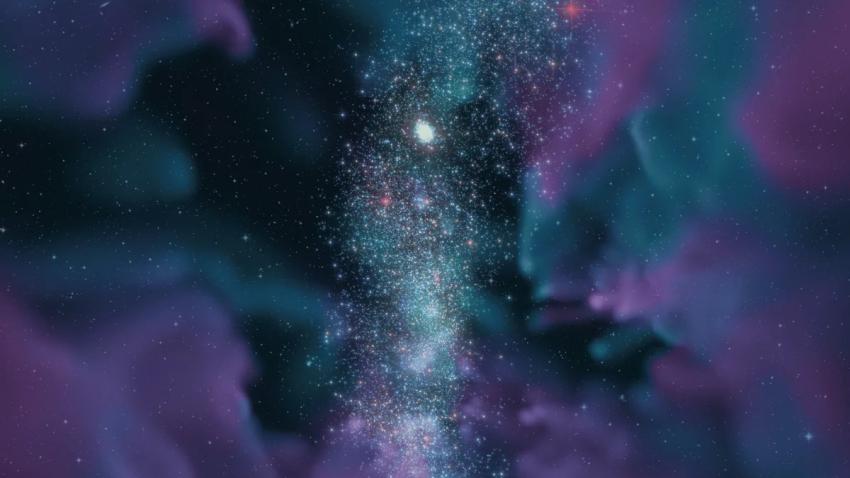
Globular Star Clusters were first discovered by Johann Abraham Ihle in 1665. They are as old as the Universe, as massive as the smallest galaxies, and the densest stellar systems known. Yet, until recently, how they formed remained a mystery. Some models suggested that they form inside their own ghostly dark matter halos — as we think galaxies do. Others, suggested that they form in-between galaxies as they collide and merge with one another. And, a third class suggested that they form inside massive galaxies, being the high mass end of clustered star formation. We have recently run the first high-resolution simulations of galaxy formation in which both dark matter rich dwarf galaxies and dark matter-free globular star clusters naturally emerge. Remarkably, we find that globular star clusters form along multiple pathways —all of the proposed mechanisms are correct to a degree. But, perhaps most exciting is that we predict the existence of a new kind of object — a single star cluster that forms inside its own dark matter halo. This new class of galaxy may have already been found hiding in plain sight in our cosmic backyard. If so, these enigmatic objects promise exciting new insights into the formation of the first stars and the nature of dark matter itself.
Speaker biography:
Prof. Justin Read is a Professor of Astrophysics at the University of Surrey and co-founder of the Surrey Astrophysics group. His main area of research is gravitational probes of dark matter, studying everything from the tiniest galaxies in the Universe, where we can measure how dark matter clusters on the smallest scales, to giant clusters of galaxies, where we can produce images of the distribution of dark matter using gravitational lensing.
Prof. Read completed his PhD in theoretical astrophysics at Cambridge University, UK in 2004. After a two-year postdoctoral research position, also in Cambridge, he moved to the University of Zürich to join the computational science group. In 2009, he joined the University of Leicester as a lecturer in theoretical astrophysics, and in October 2010 he was awarded an SNF assistant professorship at the ETH Zürich. In April 2013, he took up a full Professorship at the University of Surrey to co-found the new Astrophysics group. Prof. Read was awarded the 2013 MERAC Prize by the European Astronomical Society for his high impact research in computational astrophysics and cosmology. He is a fellow of the Institute of Physics, the Royal Astronomical Society and the Royal Physiographic Society of Lund.
This talk is exclusively for Friends of the RAS members
Want to attend talks like this? Learn more about becoming a Friend and get access to special events, talks, newsletters, and more.
Accessibility Information
Please note that this venue is currently not wheelchair accessible as the ramp is temporarily out of order, and step-free access is unavailable.
We sincerely apologise for any inconvenience caused. We are committed to improving accessibility and are working to address this.
If you have any specific access requirements or questions, please contact us at events@ras.ac.uk or call us on 020 7734 4582 .